A Quick Note:
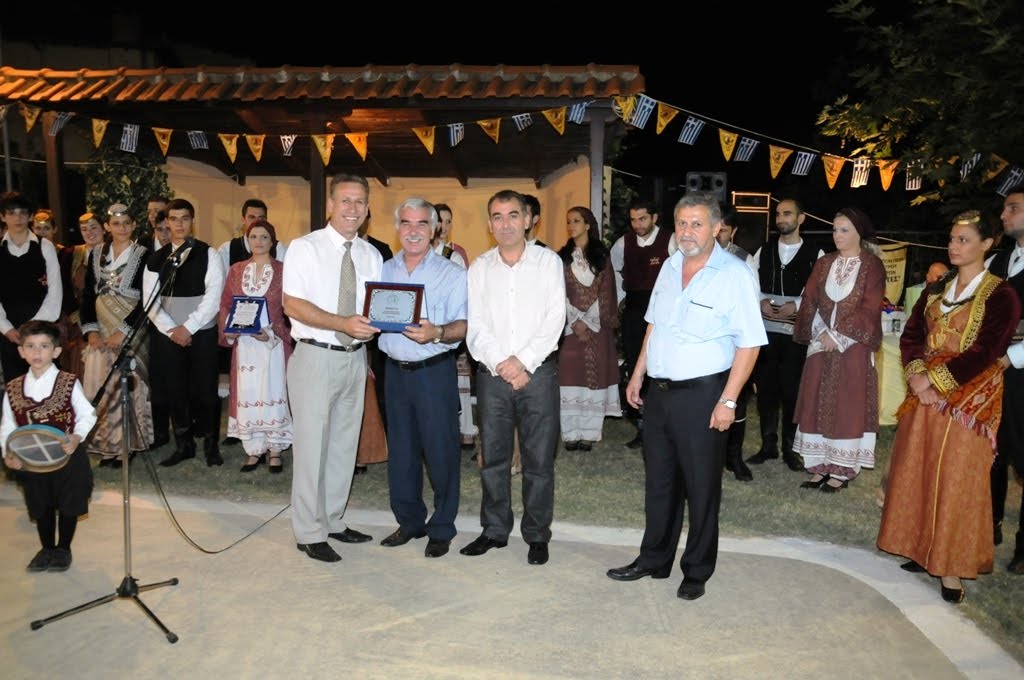
 Pontic Greeks are ethnic Greeks that historically hail from the Black Sea Region and the northern Turkish area of Pontus. Home to a large presence of Hellenism for centuries, most of the Greeks began being forced out of the area of Pontus in successive waves staring in the early 20th century. Today, very little remains in Pontus of the once large population - with Pontic Greek communities now scattered throughout the globe - including several large communities dotted around the periphery of the Black Sea. (Many of which have retained their Pontic Greek culture). This interview helps bring to light a branch of our culture that many are unaware of.
 DailyFrappe:
 You have an interesting name. Is there a story behind it?
EK: I was born Eleftherios Konstandinidis to Eleni and Elias Konstandinidis. I was named after my grandfather on my mothers side, who was from Trapezounda, Turkey. My last name was changed when I was a child. My father experienced some problems while working in factory in N.E. Philadelphia and was told to have his last name shortened. I became Eleftherios Kostans.
 DF:
DF: Tell us more about your roots.
EK: We came to the US from Katerini Greece, from a neighborhood known as the (Evangelika), about 45 minutes south of Thessaloniki on the coast. In 1965 when we immigrated to the states, at that time Katerini's outlying city limits were just tobacco fields. As refugees coming from Pontos during the exchanges and War with Turkey around 1923, my fathers family was given land from the Greek government. A common practice for many refugees coming from Asia Minor.
 DF:
DF: When did you move to the states?
EK: We immigrated to the US when I was still a baby in 1965. As tobacco farmers living in a one room shack at the edge of town, our family was unable to survive in Greece. My brother John, mother Eleni and father Elia and I came on a ship called the Christopher Columbus that same year. My mother has told me, we came with a sack of potatoes and onions, and about 75.00 dollars. Because my mother was born in Russia, applying to the US for immigration for us at that time, was more accessible for foreigners.
A Pontian woman who my mother was acquainted with originally from Katerini, (who now lives in Canton Ohio), helped us settle here outside of West Philadelphia in a Greek neighborhood called Upper Darby, where I still live today.
 DF:
DF: You have Pontic Greek blood in your lineage, trace that back for us a little bit.
EK: Both my parents are Pontian and came to Greece in two different waves. My fathers family came during the exchanges around 1922-1923 from Kars, Turkey. My mothers family took a different route. They fled East to Krasnadar in Russia (during the Russian Turkish wars 1913-1915) where she and her brother were born.They went there from a small village outside of Trapezounda, Turkey (Trabzon today) called, Megali Samerouksa. The Greeks in southern Russia were very powerful there and formed a semi autonomous community. In the 1930's Stalin put an end to all. He broke of the region by imprisoning many, while putting others on trains and sending them into exile in various parts of the Soviet Union. My grandfather Eleftherios Eleftheriadis was imprisoned at that time for professing his ethnic identity as Greek. He was given the option of becoming a Russian citizen or taking his family and immigrating to Greece. In 1940 half of the family, immigrated to Greece. They were resettled in a village outside of Katerini, Greece called, Nea Trapezounda.
 DF:
DF: When did you begin to document the history, stories and communities of Pontian Hellenism?
EK: I have been documenting Pontian culture for some 15 years in North America, Greece and Turkey. I began this first and foremost because I was interested in understanding my roots and the fact that I have family from as far away as Kazakhstan. Although I was raised Greek and in a Greek neighborhood, my parents never talked much about the past it was too painful. It all started with an initial trip to Greece around 1993. I was working as a photographer with the Philadelphia Inquirer for more than 7 years and had done much work with the French Press. I had experienced a lot of what a photojournalist goes through in reporting. After that initial visit which lasted three months in Greece and much thinking I began to crave a change. I moved away from being a photojournalist and decided to concentrate almost exclusively on documenting Hellenism. And because there was almost no work done in the area of Pontian Culture, I felt it was important that a body of work about the culture should exist. My son who was born here in the states is going to grow up knowing everything I can offer him. I don't want him going through life not knowing his history or his roots and having to take a lifetime to find all these things out. So I continue to research and go. I am currently researching other places where I feel it is important to include in this documentary, such as Russia, Germany and Georgia. There are villages, celebrations and communities that are tied to this culture that need to be seen and shown. If I can explore and document more I will. I feel it will be a lifelong body of work.
 DF:
DF: What was your inspiration for it?
EK: There have been many inspirations for me to continue with this work. Visiting a Pontian refugee village in Thrace, Greece; Visiting my ancestral village in Turkey, or finding my great aunt in Almata, Kazakstan, who was lost behind the lines of the former Soviet Union for 50 years. These are just a few of the wonderful moments that have inspired me to keep going. I generally live a very frugal life; but my experiences have left me enriched. The most important experience was my initial visit to Greece at the age of 30. I came to Greece in part to research the Macedonian issue. Coming as an American photographer I was in part on assignment working through a grant. I stopped through Katerini, Greece looking for my place of birth. When I arrived, I had a photograph of a small shack in black and white in my pocket and an address. I drove to the back of the town and found the shack I was born in. Some of the senior neighborhood women there told me the story of my families immigration and their difficult lives. I was very moved. That was the beginning for me.
 DF:
DF: What was it like the first time you went to Panagia Soumela?
EK: When I first went to Panagia Soumela, Greece I did not understand the significance. I went with the understanding that I was going to a religious event on the 14rth and 15th of August, The Dormition of the Virgin Mary. I went alone and slept in my car outside of the monastery for the two day event and watched mostly. During the first day the grounds of Panagia Soumela are like a giant street bazaar, while services inside the church begin. Late in the afternoon-evening things change. There is an intensity in the air and look on peoples faces.The number of people begins to swell around the monastery and you could feel that a very spiritual moment will be taking place shortly which is the procession of the Icon of the Virgin Mary. I remember being taken by the various costumed clans of Pontian dance groups. With a camera around my neck, I walked through the crowds listening and looking for images to create. I could hear people speaking Pontian, Russian, Turkish and English. I realized that people had come from all over the world and it left me surprised and inquisitive. I remember reflecting on life in the states and feeling this event was so distant from my life there. Since them, I have returned many times to Panagia Soumela in Greece, Trabzon Turkey and Panagia Soumela in New Jersey, USA which was reestablished just a few years ago.
 DF:
DF: From your personal experience, how many Pontian Greek speakers do you think still reside up in the mountains of Pontus in Turkey?
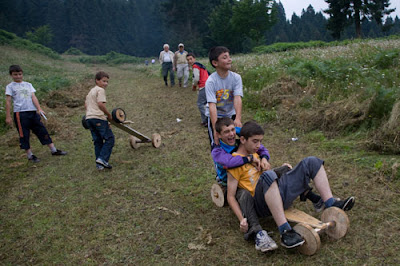
EK: It's tough to say. Expert opinions vary. They range from hundreds of thousands to ten of thousands. When I look to photograph the Pontian people in Turkey, I try to feel my way around more than anything. I general focus on listening to language. If I hear this, I know for sure. But other cultural aspects which include food, dress style, music and dance and daily living are part of all this too. Because so much of the culture is now interwoven with Turkey you have to consider these cultural aspects when concluding who is Pontian. Many people carry on the traditions but do not speak language. Some are just plain scared to talk about there ethnic identity. Turkish nationalism runs deep. Does that take away from them being Pontian? Others, simple call themselves Rum. Which means they were part of the ancient Eastern Roman church we call Byzantium. That certainly makes them Pontian. I can remember on several occasions being told by villagers i met, "Please come and stay with us. We are the same. But don't ask to many questions". This past year I spent I believe there are hundreds of thousands of people that are Pontians living in Turkey today.
 DF:
DF: Do you think the Greek government and diaspora organizations around the world do enough to forge ties between the groups?
EK: We all know that Greeks have an independent streak amongst themselves that is a double edged sword. Pontian organizations quarrel constantly like any other. These last few disagreements have left organizations in North America, Europe, Australia and Greece in some difficult circumstances. For one, they have been very focused on the past (genocide). It's a valid point. Uniting is very difficult still. Some major changes are going on in Greece. The two major national cultural organization are vying for control. The old school mentality has to change. Younger, better educated people are now starting to take control. The internet is going to help this along also. As for the government, corruption and inclusion by way of taking care of your friends first is still the name of the game. Also, outside pressure to play down the genocide issue is a constant battle for these organizations. I think this is a large point that needs to be tackled. But to do so, means people will have to stand together first. Its a daunting task, when you think about Greeks and organizing.
 DF:
DF: Has enough been to talk about the Greek Genocide and to teach the world about what really happened?
EK: There has been a dramatic increase to popularize Pontian history and culture these past ten years. There are scholars, artists and especially musicians that are carrying this forward. The internet and media (documentaries) have provided venues and made good strides to bring much of this history and culture to the forefront. This has also brought people in Turkey forward examining their own history and truth by communicating and building relations with others outside of their own country. I believe the Olympic ceremonies in Athens in 2004 was a proud moment for many who saw Pontian dance and history included in the program.
 DF:
DF: You have made it a mission of yours to document and photograph the Pontian Greeks. Are you coming out with a publication to view your work?
EK: When I began to photographic Pontian culture I spent a lot of time researching visual documentaries. I found limited good modern photography about Pontian culture. The ultimate goal is to produce a photographic book and major exhibition that will travel. It will tour many locations in North America, Europe, Greece, Turkey and where ever people are interested in seeing and understanding Pontian culture. I feel it will help bring people together, especially Christian and Muslim Pontians. I have been working on this without funding which is quite challenging. I'm really looking for a patron or a foundation that will take this idea to heart and help me complete the mission.
 DF:
DF: Do you think that future generations will be able to perpetuate and hold on to the Pontian Greek culture?
EK: Music is at the center of Pontian culture. Language and dance continue to be spoken because of the growing popularity of this music. On a global scale it will continue to survive and has been well documented. In a common setting such as daily village life in Turkey, it will depend on the progress to democratize the state and allow freedom of religion and for people to study their own language. At the moment it's still illegal for this. I'm afraid to say that if things do not change soon there, it may be lost and treated as a form of nostalgic reference to be used much the way it is used today in Pontian/Greek culture. There have been great efforts made these past few years by several leading figures, like Omer Asan and Adem Bskoylu (in Turkey) to help keep the language alive. But we need more.
DF: Fascinating, Eleftherios. Best of luck with all your projects!
 Eleftherios Kostans
 is an award winning freelance photographer based in the Metropolitan Philadelphia area. He is the staff photographer at Swarthmore College in suburban Philadelphia where he contributes to a variety of publications. Eleftherios worked as a contract photographer with the Philadelphia Inquirer for more than 10 years and was a correspondent to Sipa-Press Photo Agency in New York. His work has appeared in a variety of international publications such as Newsweek, Time, People, Paris Match, and Wired magazines.
His personal work around the Black Sea and Eastern Europe focus on Hellenism where he has been documenting Hellenic life.
Click here to learn more about his work.Πηγή:
Daily Frappe